Name’s Yevhenii, sometimes RisiaYeda.
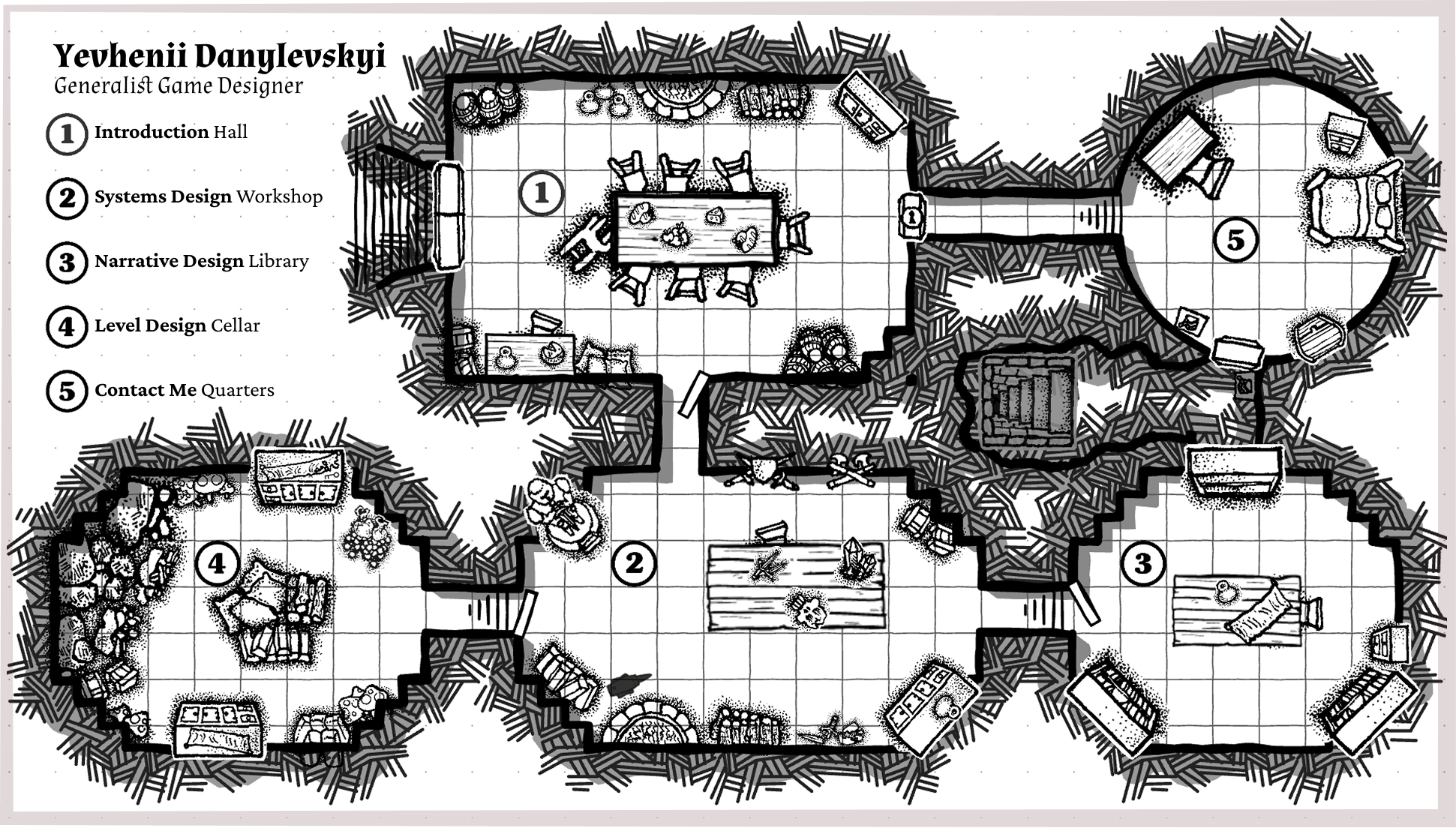
I love building games and stories, and so my main pillars as a game designer – systems, narrative and levels, – will be presented as entries in this dungeon-style portfolio.
Every interactable will have a case overview and a flavor text in italics below – to add a bit of immersion to this adventure.
The first room is dedicated to, well, the introduction: projects that I’ve worked on, workplaces and a bit of my background. —————————————————————————– A large hall with a dining table suited for half a dozen guests. It looks like it was prepared to host an evening, but not a soul is in sight.
The second room is a gallery of mechanics and ideas, a brief history of their different issues and iterations, and the decisions behind them. —————————————————————————– A large workshop, crowded with masterwork armaments and tools of enchantment.
The third room is an archive of my own narrative guidelines: the what, when, why and how of my writing process. —————————————————————————– A small personal library. Its corners littered with scattered stone debris.
The fourth room is a vault of my layouts, techniques, and the design reasoning behind them. —————————————————————————– A damp, dripping cellar. Collapsed stone and debris litter the far wall.
The fifth room – CV and contact links. —————————————————————————– Quarters with an unmade double bed. In the corner stands a heavy stone door, an iron lever mounted to the floor beside it.
Corepunk is a large-scale MMO with MOBA elements, where for close to a year I used blueprint systems to work on artifacts, runes, mobs and map events within a 100+ people company – endless Jira tickets, cross-functional teamwork and tight deadlines included.
One of the best experiences I’ve had: an old and extensive project to get a hang of, a lot of room for creativity and a team of many wonderful workmates. —————————————————————————– There is half-eaten food on the table. One of the chairs has been toppled.
It started with the first browser games I played in school; was followed by the first Minecraft mod I made, customized tabletop mechanics and a math-based education; and continues with my work as a full-time game designer and freelance TTRPG game master.
Favorite games: Warframe, Outer Wilds, VA-11 Hall-A, Disco Elysium and League of Legends. —————————————————————————– A small counter serves as a food preparation surface, with a piece of lamb ready to be roasted over an open fire. Rare spices have been used lavishly.
TapHub Games is a growing mobile games company, where for almost a year I’ve been creating systems and levels for various small projects – from core loops and prototypes to fine-tuning balance and pacing.
Ultimately, classic mobile gamedev isn’t for me – but this experience was important for my understanding of what I want to be growing within the industry: mechanics and levels that serve the story. —————————————————————————– The coals in the fire are barely smoldering. A faint smell of brimstone hangs in the air.
It has been almost 5 years since I entered my first D&D dungeon (where my lvl2 sorcerer died in the first room). Ever since, I’ve been enchanted by TTRPGs, enjoying them both as a player and, mostly, as a game master – I’ve built countless worlds, guided thrilling stories and hacked the rules of so many systems. —————————————————————————– It looks like the door was shut by an external mechanism – a protective magical field still lingers, and there are no signs of a fight.
Corepunk’s artifacts – stat-upgrading items for player characters, – needed more uniqueness. As a solution, I designed various artifacts’ passive abilities – to diversify player builds and choices.
Paladin’s Fury needed a new passive that would: a) be better aligned with a paladin’s theme, b) synergize with the artifact’s stats. So I’ve designed and implemented a burning, close-range aura that is maintained by basic attacks.
Flux Strike already had an interesting and interactive passive, but it needed my adjustments for some edge cases – interaction with hybrid abilities and non-damaging magic abilities.
Steamwing Spellguard had one-hit effect passive – but needed a fix to suit the mismatched two-hit animation. I’ve split the hit into two equal parts, configured timings and made sure that two parts of the shield were stacking. —————————————————————————– A pair of daggers. Fresh runes carved into the steel, awaiting enchantment.
Every MMO needs new and interesting enemies – Corepunk isn’t an exception. Unfortunately, there is no enemy database for this game – so I’ll reference the official patch notes (February 6, v0.94).
Ghoul “family” needed new, unique enemies – so I’ve designed Ghoul Skull Crusher as a “barbarian/paladin” archetype: a) Charge that slams ghoul’s hammer into the first head on it’s way – dodgeable, but lethal if caught due to the stun; b) Roar that increases damage for ghoul’s nearby allies – with interruptable cast time, to give players a bit of counterplay; c) Defense Stance – that ability was scrapped, but was meant to give a window of high defense, forcing players to react/change targets. —————————————————————————– A massive, recently scoured human skull…
(Following the skull interactable on the left):
Ghoul Bomber was meant to be an “elite upgrade” for the default ghoul-tank. So I’ve worked on the following abilities: a) Blast Shield Bash was an upgrade to the default ghoul-tank ability – a bit more damage and an additional blast cone behind the hit; b) Locomotive Charge – signature ghouls’ ability, where the mob damages and knocks up everything in its way; c) Power Swing – the attack damages and pushes enemies outwards, designed to combo with Locomotive Charge; d) Naval Mine Detonation – was scraped due to engine limitations, but was meant to be a “last stand” massive suicide explosion. —————————————————————————– …one socket missing its ruby eye.
As an addition to Corepunk’s artifact system, runes give players an option to replace the artifact’s passive with a dedicated active ability. Here are a few I worked on:
Healing Star was intended as a healer’s rune used specifically to sustain ally tanks/fighters: a) skillshot is easier to apply to low-mobility melees; b) healing-over-time is more effective when an ally can survive long enough to get the full effect. The upgraded ability leaned even more into a maintained healing playstyle; overclocked, on the other hand, gave an additional strategic option for players.
Mana Donor was a simple and straightforward option for supports: the defaut rune buffed one ally’s main stat; upgraded turned into team-wide buff; and overclocked gave an “emergency button” for low-mana allies. —————————————————————————– A large, polished crystal. Leaning close, you catch the sound of a quiet wail from somewhere within.
“Choose from 3 upgrades ➤ watch ally and enemy units battle ➤ repeat if battle is won ➤ receive rewards after winning a chain of battles.” This was the core game loop of the NDA game I worked on at TapHub Games, with a concept similar to Fort Guardian.
The core loop was intentionally simple since it was designed for quick sessions on mobile. Semi-random upgrades created replayability; each level (chain of battles) encouraged different strategies; meta-upgrades between levels gave the feeling of progression. —————————————————————————– A display of masterwork weapons hangs on the wall, their edges pitted with red rust…
(Following the swords and shield interactable on the left): During prototyping, the core loop felt good, but there was a source of frustration: weak upgrade or an unlucky battle could restart the entire run.
So, I designed additions to the core loop: a) gates and archer towers – they gave the player an HP buffer and killed remaining enemies if the battle was close, preventing random losses; b) mana system for spawning additional troops on-demand – an option to temporary increase the player’s power to give the player additional agency and flexibility in their strategy, and, again, prevent random losses. —————————————————————————– …though a few small, empty brackets suggest something was taken.
Wild Words Engine, which I’m using to build my TTRPG, has a subsystem called Twists: after rolling a pool of d6s, any rolled double introduces a small, player-created addition to the scene.
I wanted to give the player characters and the surrounding world a feeling of uncertainty, so I’ve tweaked Twists to change depending on the highest double in the roll: ⚬ doubles of 1-2-3 trigger Outage – a specified character’s flaw; ⚬ doubles of 4-5 trigger Twist – a small positive addition or a trade-off in the scene; ⚬ doubles of 6 trigger Resonance – a critical success.
In addition, this synergizes with the dice system: a) bigger dice pools result in more doubles – an expert character has a higher chance of doing extra well and an easier time doing the job, but suffers more from their own flaws; b) the outcome of the action is decided by the highest number in the roll. The “Cut” difficulty system removes n highest numbers from the roll – which lowers the chance of higher (better) doubles. —————————————————————————– A masterfully built forge – though it has long since gone cold.
Prison Island – Corepunk’s flagship extraction dungeon, – needed mini-events to diversify the game loop. I’ve designed Fight to Survive (patch note of February 6, v0.94) – an interactable event where players need to survive enemy waves in a shrinking circle to get the reward.
Main points: 1. Among other options, I’ve decided on a soft event boundaries – players can trade-off HP to maneuver better, which expands tactical desicions. 2. I’ve chosen locations on the map with choke points and elevation changes to, again, expand players’ availible tactics. 3. While making the event entities, I’ve made sure they’re easy to configure, scale and duplicate for other designers. —————————————————————————– A set of finely crafted armor sits on a stand, shrouded in thick dust and clinging cobwebs.
I believe that every world needs two anchors: a) a clear, easily understood vibe and central conflict; b) specific pillars that show players how, when, and why they can interact with the world.
For instance, my Residue setting: a) it is an arcane wasteland born from a powerful, nation-wide cataclysm happened at the end of global war in industrial technomagic world – and many want to discover buried secrets within; b) this wasteland has a dangerous borderzone; filled with planar instabilities and mutating radiation; basic needs are hard to fulfil, but artifacts inside are extremely valuable. —————————————————————————– An Infernal manuscript on the table. Its dark text covered by recent remarks in Dwarven.
Quotes and descriptions must serve at least one of these purposes: a) valuable information: something players can use immediately or down the line; b) character attitude: A reflection of how an NPC or faction views the player; c) world flavor: Sensory details or lore that deepen immersion and atmosphere.
Examples from my Residue setting: a) a log entry detailing an anomaly, a scavenger’s warning about a nearby mutant; b) a dialogue bark revealing the Remnant Legion’s hostility toward outsiders; c) The gritty, desperate tone across all examples, reinforcing the bleakness of the wasteland. —————————————————————————– A largely bare bookshelf masking a faint, persistent draft from somewhere behind the wall.
While designing a faction, I think about 2 main pillars: a) how it adds a new perspective to the story; b) how it’s distinguished from other factions.
As an example, in my Residue world: a) The Iron Bones seek military control and lost technologies for their nation; The Amber Disciples want a cure for their mutations; The Scavengers seek only profit in the Residue; The Remnant Legion wants to bring back and renew their land; b) The Iron Bones – militarism and necromancy; The Amber Disciples – mutants and despair; The Scavengers – freedom and profit; The Remnant Legion – sentient constructs and history. —————————————————————————– A bookshelf choked with dust, packed with bestiaries, tomes of metallurgy and enchanting folios. One volume stands out, handled so often its leather spine is completely clean.
Coming soon. —————————————————————————– A shelf of old, recently salvaged manuscripts. A gathering of various tongues, all detailing the outer planes, summoning rituals and infernal bargains.
Level design in Salad Knight had 2 goals: a) teach players new mechanics; b) be clear and non-confusing.
The detailed design document is located here. In short, I’ve: a) utilized repetition to teach players new mechanics while slowly increasing difficulty; b) used old mechanics in new levels, combining them with the new mechanics; c) set up safe backtracking routes to avoid confusion and softlocks. —————————————————————————– A heap of pine logs, sacks of gravel, and heavy iron ingots.
The Forge of the Forgotten Dwarves was desiged with one thing in mind: I wanted to make a short, one-page dungeon interesting to explore.
So I’ve used: a) non-linear pathing: players can start the dungeon either through a puzzle-door or a smoking chimney; enter the forge through recurring door puzzle with a complication or through secret passages; explore every room or skip some to spend fewer resouces. b) environmental storytelling: charred cave wall indicating a chimney; wine barrels along with peaceful, singing goblins; a skeleton at the bottom of the pit. —————————————————————————– A faded regional map lies on the cabinet, some marked ruins crossed out entirely. Beside it, a heavy key radiating a faint, pulsing ward.
Coming soon. —————————————————————————– Yellowed blueprints of this complex rest on the cabinet. A dark cross is marked right between the library and the living quarters.
Link —————————————————————————– An unfinished letter rests on the desk: a desperate, half-written appeal to the old friend.
Email – risia.yeda@gmail.com LinkedIn – linkedin.com/in/risiayeda —————————————————————————– A chest of most valuable belongings: glinting enchanted jewelry, brittle scrolls, and a locket hiding the portrait of a young dwarven woman.